DKNOG16

Europe/Copenhagen
Grand Ballroom (Scandic Copenhagen)

Grand Ballroom

Scandic Copenhagen

Vester Søgade 6, 1602 Copenhagen
Description

DKNOG16

📺 Re-Watch DKNOG16 on YouTube! 📺


DKNOG16 will be on March 5-6 2026 at Scandic Copenhagen.

Don't miss the chance to meet people with different backgrounds from the networking industry and create new connections. Whether you are a fresh graduate or a senior professional, learn something inspiring and catch up with the latest technology trends.
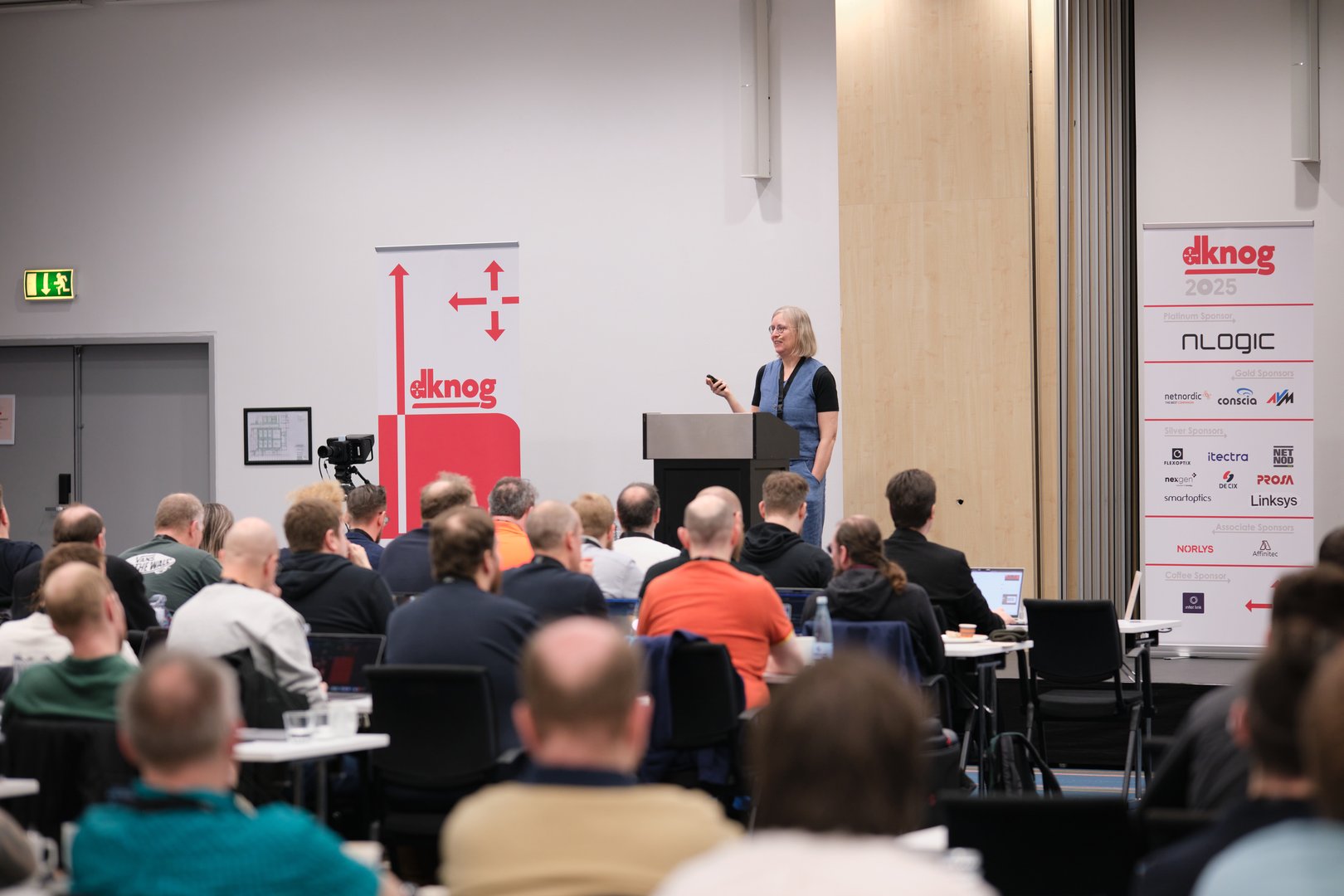
 

DKNOG session


Sponsors

The DKNOG conference could not be arranged without the generous sponsorships from the following organizations and companies:

Platinum

Gold

Conscia EPS Global Itectra  

Silver

  Cloud ACS

  Fritz! logo

Associate 

  Sinal RIPE NCC Netbox Labs


Coffee


Participants
Surveys
DKNOG16 General Survey
Feedback - A different way to success
Feedback - ASPA: the new protocol for improving BGP routing security
Feedback - Auto-bandwidth for SR-TE
Feedback - Automate what makes sense: Data, principles and practice
Feedback - Channelmania! – future proof your DWDM network topology while keeping it flexible for 1.6T
Feedback - Command-Line to Codebase: Learning Software to Expand Your Engineering Toolkit
Feedback - Geopolitics and Digital Sovereignty in Greenland
Feedback - How far can you get with IX Route Servers?
Feedback - Introduction to Design-Driven Network Automation
Feedback - IXP+ based observations on peering and routing changes after Middle East cable outages
Feedback - Lost in translation: philologist tries to decode the Tech-Sales Interface
Feedback - Merging Service Provider Networks
Feedback - Network Automation in the Modern Age
Feedback - Old habits die hard, how to kill them easily
Feedback - Sovereignty for whom? Between digital (in)dependence and Big Tech expansionism
Feedback - The DKNOG Quiz!
Feedback - Understanding and optimising transceiver efficiency using internal metrics for improved power savings
Feedback - Who put the "inter" in internet?
    • 9:00 AM 9:45 AM
      Breakfast and registration 45m North Lounge

      North Lounge

      Scandic Copenhagen

    • 9:45 AM 10:00 AM
      Welcome and messages 15m Grand Ballroom

      Grand Ballroom

      Scandic Copenhagen

      Vester Søgade 6, 1602 Copenhagen
      Speaker: Lasse Jarlskov (DKNOG)
    • 10:00 AM 11:00 AM
      Who put the "inter" in internet? 1h Grand Ballroom

      Grand Ballroom

      Scandic Copenhagen

      Vester Søgade 6, 1602 Copenhagen

      More to come

      Speaker: Poul-Henning Kamp
    • 11:00 AM 11:30 AM
      Coffee Break 30m North Lounge

      North Lounge

      Scandic Copenhagen

    • 11:30 AM 12:00 PM
      Introduction to Design-Driven Network Automation 30m Grand Ballroom

      Grand Ballroom

      Scandic Copenhagen

      Vester Søgade 6, 1602 Copenhagen

      Design‑driven automation treats the high-level design of infrastructure as a first‑class artifact: an explicit model of topology, roles, relationships, and constraints that exists independently of any particular device configuration.

      In this talk, we will explore what design‑driven automation means in practice, why it emerged, and why it keeps resurfacing whenever networks reach a certain level of scale or complexity. We will look at how working from a design model changes everyday operational thinking — from how state is understood, to how drift is interpreted, to how refactoring and unplanned change are handled.

      We will trace how these ideas have evolved, from early topology‑aware network management and fabric controllers to modern intent‑based and fabric‑oriented systems. The focus will be on the underlying mechanics: how networks are modeled, how change is reasoned about over time, and where design‑driven approaches help — and where they still struggle in real operational environments.

      Speaker: Mark Coleman
    • 12:00 PM 12:30 PM
      Network Automation in the Modern Age 30m Grand Ballroom

      Grand Ballroom

      Scandic Copenhagen

      Vester Søgade 6, 1602 Copenhagen

      Network Automation has been around long enough that it progressed through different stages. In the early days network engineers were happy that we could write templates, merge them with variables and push the result out to the devices.

      By now, we can see that we need a place where to store those variables in a sensible way, through documentation systems (or DCIMs). But with this we enter a new stage of automation, which brings increased complexity and additional knowledge requirements to the people designing the automation and documentation systems. We need to understand our data and our models better than ever before, and make our decisions based on how we model the world, without being constrained by the limits of our documentation systems.

      This is not a "here is the solution" talk. This is more the beginning of a longer conversation we want to start in the networking community, showing where we, the network people, need to figure out for ourselves what is still lacking in our automation skill and toolsets and how to progress from here.

      And maybe a glimpse on an early draft of a potential solution.

      Speakers: Marcus Stoegbauer, Veit Heller
    • 12:30 PM 1:30 PM
      Lunch 1h Restaurant

      Restaurant

      Scandic Copenhagen

    • 1:30 PM 2:00 PM
      Sovereignty for whom? Between digital (in)dependence and Big Tech expansionism 30m Grand Ballroom

      Grand Ballroom

      Scandic Copenhagen

      Vester Søgade 6, 1602 Copenhagen

      Recent geopolitical tensions have placed digital sovereignty as a key buzzword in public and political debates, emphasising the dominance of US-based tech corporations across the digital market. In Denmark, the Minister of Digitalisation has taken several measures to ‘liberate’ the public sector from infrastructural dependencies and the economic consequences they entail. Meanwhile, corporations such as Microsoft, Amazon, and Google increasingly promote their services as tools for enhancing sovereignty (e.g., through offering national data storage, risk assessment tools, and so forth). Sovereignty is, in other words, a deeply political concept, characterised by distinct ambiguity and several (conflicting) interests.

      In this talk, we provide an overview of the variety of ways different stakeholders use the concept of sovereignty to steer the political debate and ultimately consolidate existing and emerging forms of power. On this basis, we argue that a persistent focus on applications and services rather than the underlying infrastructures is hindering more fundamental discussions of the power structures that shape digital ecosystems. As an alternative perspective, we provide a series of examples from our research on global submarine data cables, emphasising the altered ownership structures and conditions around global internet routing. Through this, we open up for discussions of how to better connect the dots between the ongoing sovereignty debate and the technological and economic realities faced by industry professionals.

      Speakers: Dr Signe Sophus Lai (University of Copenhagen), Sofie Flensburg (University of Copenhagen)
    • 2:00 PM 2:15 PM
      Geopolitics and Digital Sovereignty in Greenland 15m Grand Ballroom

      Grand Ballroom

      Scandic Copenhagen

      Vester Søgade 6, 1602 Copenhagen

      Greenland’s digital ecosystem is characterised by structural dependence on U.S.-controlled infrastructure across multiple layers: limited international backbone connectivity via a small 2 submarine cables and limited satellite links, routing and traffic flows largely terminating outside Greenland.

      This talk examines how constrained path diversity, external routing and hosting, minimal local traffic localisation and vulnerable infrastructure intersect with heightened geopolitical attention.

      The slides for this presentaion can be accessed here: https://www.canva.com/design/DAHCs0CGAas/7evoVC1E0QgefQbs5CIdvw/view

      Speaker: Signe Ravn-Højgaard (Tænketanken Digital Infrastruktur)
    • 2:15 PM 2:30 PM
      Old habits die hard, how to kill them easily 15m Grand Ballroom

      Grand Ballroom

      Scandic Copenhagen

      Vester Søgade 6, 1602 Copenhagen

      We have an issue in the network industry - we're stuck in the ways we think and the ways we work.
      Why change something just to change it? Well, why not? This lightning talk aims to challenge our industry's resistance to change and provides food for thought on breaking free from outdated practices.

      Speaker: Martin Willems Kristiansen (Norlys Mobil A/S)
    • 2:30 PM 3:00 PM
      Command-Line to Codebase: Learning Software to Expand Your Engineering Toolkit 30m Grand Ballroom

      Grand Ballroom

      Scandic Copenhagen

      Vester Søgade 6, 1602 Copenhagen

      This talk is a short, practical story about a network engineer who wanted repeatable ECMP troubleshooting and also wanted to learn a new programming language. Starting from familiar tools (traceroute, Wireshark, RFCs), I built a small ECMP‑aware probing tool and translated manual workflows into code.

      The focus is less on the tool itself and more on the method: start in a domain you trust, measure everything, and build in small slices. I’ll share the learning process I followed: start with familiar tools, test one change at a time, explain results to yourself as you go, and how I got unstuck when progress stalled.

      Attendees will leave with concrete, low‑risk ways to start small software projects in their own networking work: how to pick a problem, how to validate changes, and how to keep momentum even when day‑to‑day priorities shift.

      Speaker: Thomas Kjær
    • 3:00 PM 3:30 PM
      Coffee and Cake 30m North Lounge

      North Lounge

      Scandic Copenhagen

    • 3:30 PM 4:00 PM
      Channelmania! – future proof your DWDM network topology while keeping it flexible for 1.6T 30m Grand Ballroom

      Grand Ballroom

      Scandic Copenhagen

      Vester Søgade 6, 1602 Copenhagen

      In the old days of traditional separation of IP and DWDM, there was no need for IP folks to care about much other than what they used on their routers/switches (while the transport team ran the DWDM infra). These past DWDM infra approaches for maximizing the data capacity per fiber pair went for running more and more DWDM channels with grid spacings as small as possible. This meant that grid spacings shrank from 200GHz to 100GHz and then 50GHz with some applications even going for 25GHz.
      Now in the age of IPoDWDM the bandwidth per channel keeps increasing, as complex modulation schemes come into favor over ON-OFF-Keying which has been the de facto standard so far. Those increased per channel bandwidths of 400Gbps, 800Gbps and now pushing into the 1.6Tbps realm demand for larger grids to accommodate the spectrum necessary to operate such “Superchannels”. Especially the fact of coherent detection being “blind” to anything but its own wavelength has enabled interesting topologies that can omit filters altogether. Of course that comes at a cost of reduced flexibility. Which means, IP folks now will need to understand the nuances of how coherent detection works, need for larger filters for 800Gbps and higher, and how 400GHz filters (key word here being COTS) would future proof your network by not only allowing you to grow to 1.6Tbps, but also allow backwards compatibility for legacy services on 50GHz, etc.
      Made by FLEXOPTIX Research - Gert and Thomas.

      Speaker: Thomas Weible
    • 4:00 PM 4:30 PM
      Lost in translation: philologist tries to decode the Tech-Sales Interface 30m Grand Ballroom

      Grand Ballroom

      Scandic Copenhagen

      Vester Søgade 6, 1602 Copenhagen

      What happens when a language teacher is dropped into the deep end of the telecom industry, with zero background in fiber, DWDM, or why “it depends” is the only honest answer to anything? This talk is a personal journey of switching careers from academia and language teaching into the world of tech sales in a fast-moving, acronym-rich, and precision-driven industry.
      The presentation will explore the early days of trying to sell services she barely understood, the awkward moments of miscommunication with engineers, and the hard-earned lessons of navigating between customer expectations and technical reality. It will touch on the cultural gap between sales and tech: how each side uses language differently, and how learning to "speak engineer" was just as hard as learning a foreign language.
      From amusing misunderstandings to practical strategies that helped bridge the gap, this talk is for anyone who's ever had to translate between departments, roles, or mindsets.

      Key Points / Takeaways:
      * Switching from humanities to telecom: a career change story
      * First encounters with technical product language (and confusion)
      * What “cannot be done” really means (and what it doesn’t)
      * Why sales and tech often miscommunicate, and how to fix it
      * Lessons in building trust with engineers
      * Learning to translate between customer needs and engineering limitations
      * Humility, curiosity, and the importance of asking “dumb” questions
      * How being a language teacher actually helps in tech, unexpectedly

      Speaker: Katja Vaske
    • 4:30 PM 4:45 PM
      DKNOG announcements 15m Grand Ballroom

      Grand Ballroom

      Scandic Copenhagen

      Vester Søgade 6, 1602 Copenhagen
      Speaker: Lasse Jarlskov (DKNOG)
    • 6:00 PM 12:30 AM
      Social 6h 30m CPH Conference (DGI Byen)

      CPH Conference

      DGI Byen

      CPH Conference @ DGI Byen Tietgensgade 65, 1704 Copenhagen V https://maps.app.goo.gl/bBh8gWWAg7uNWESv9

      18:00 - Arrival and welcome drink
      18:30 - Seating
      18:50 - 3-course dinner
      21:30 - Bar opens

    • 9:00 AM 10:00 AM
      Breakfast 1h North Lounge

      North Lounge

      Scandic Copenhagen

    • 10:00 AM 10:30 AM
      Understanding and optimising transceiver efficiency using internal metrics for improved power savings 30m Grand Ballroom

      Grand Ballroom

      Scandic Copenhagen

      Vester Søgade 6, 1602 Copenhagen

      In high-performance optical communication systems transceiver health and efficiency are critical to network reliability and energy consumption. This presentation explores the powerful capabilities of Versatile Diagnostics Monitoring (VDM) features found in modern optical transceivers (beyond the speed of 100G) with a particular focus on the Thermoelectric Cooler (TEC) current metrics. By analysing TEC current alongside temperature and cable length data we should be able to identify the optimal operating conditions that will minimise power consumption while maintaining performance. In order to prove this thesis we developed a couple of software prototypes to perform the data analysis. Using real-world VDM data this talk will demonstrate how to evaluate and visualise transceiver efficiency in terms of Watts, uncovering practical insights for engineers aiming to design or operate greener, more efficient optical networks and finally save energy.

      Speaker: Gerhard Stein (Flexoptix GmbH)
    • 10:30 AM 11:00 AM
      IXP+ based observations on peering and routing changes after Middle East cable outages 30m Grand Ballroom

      Grand Ballroom

      Scandic Copenhagen

      Vester Søgade 6, 1602 Copenhagen

      This presentation is showing and discussing observations of what trends and changes can be seen after the cable cuts near the shore of Yemen in September. We try to highlight findings and interesting changes in routing or traffic shifts.
      The findings are valid globally and not just Middle East related. It serves as a great example of do's and don'ts in your routing-setup.

      Speaker: Kaj Kjellgren (DE-CIX)
    • 11:00 AM 11:30 AM
      Coffee break 30m North Lounge

      North Lounge

      Scandic Copenhagen

    • 11:30 AM 12:00 PM
      ASPA: the new protocol for improving BGP routing security 30m Grand Ballroom

      Grand Ballroom

      Scandic Copenhagen

      Vester Søgade 6, 1602 Copenhagen

      In the past it was believed that network operators should periodically download clear text data from the Internet and put them into the configuration of their routers to make routing more secure.
      RPKI is a technology to secure routing which employs proper cryptography. For years we have used it for Route Origin Authorization. New feature of routing security is being deployed now: Autonomous System Provider Authorization.

      It complements existing Route Origin validation with a partial path validation: each autonomous system can declare which autonomous systems are expected to provide transit services. Network operators validating ASPA can then drop routes coming via unauthorized providers.

      Speaker: Ondřej Caletka (RIPE NCC)
    • 12:00 PM 12:30 PM
      Auto-bandwidth for SR-TE 30m Grand Ballroom

      Grand Ballroom

      Scandic Copenhagen

      Vester Søgade 6, 1602 Copenhagen

      The presentation covers a prototype of my auto-bandwidth solution for Segment Routing Traffic Engineering.

      The solution is open standard and multi-vendor (existing bandwidth-aware SR-TE solutions are vendor specific).

      The prototype also includes an open source tool SR-TE bandwidth sampler, which collects SR policy counters via GNMI, calculates traffic rate and converts it into the BGP-LS format per RFC9857.

      Speaker: Dmytro Shypovalov (Vegvisir Systems)
    • 12:30 PM 1:30 PM
      Lunch 1h Restaurant

      Restaurant

      Scandic Copenhagen

    • 1:30 PM 2:00 PM
      Merging Service Provider Networks 30m Grand Ballroom

      Grand Ballroom

      Scandic Copenhagen

      Vester Søgade 6, 1602 Copenhagen

      As the service provider market slowly consolidates, network engineers and architects will increasingly face the complex challenge of merging service provider networks. This technical talk dives into the intricacies of integrating distinct IP/MPLS network infrastructures, focusing on practical considerations and potential pitfalls. Based on past experience, we will discuss the general approach to such a project, key architectural considerations, and challenges related to routing protocols and vendor interoperability.

      Speakers: Bastian Hoss (Xantaro Deutschland GmbH), Markus Jungbluth (Xantaro Deutschland GmbH)
    • 2:00 PM 2:30 PM
      How far can you get with IX Route Servers? 30m Grand Ballroom

      Grand Ballroom

      Scandic Copenhagen

      Vester Søgade 6, 1602 Copenhagen

      Route servers are the most important service (other than moving packets itself) on an internet exchange fabric, however in most exchanges peering with them is not mandatory.

      This talk aims to answer the question of how effective route servers are and distributing routes to many networks, using the large internet exchange deployment footprint of the bgp.tools route collector network, we will look at how relevant internet exchange routes servers are, and how many people (and who) actually import from them.

      Speaker: Ben Cartwright-Cox (bgp.tools)
    • 2:30 PM 3:00 PM
      Coffee and cake 30m North Lounge

      North Lounge

      Scandic Copenhagen

    • 3:00 PM 3:30 PM
      Automate what makes sense: Data, principles and practice 30m Grand Ballroom

      Grand Ballroom

      Scandic Copenhagen

      Vester Søgade 6, 1602 Copenhagen

      “Automate what makes sense” sounds practical. In many network orgs, it becomes a permanent excuse to not automate anything.

      This talk explains why automation stalls even when the tools are fine: unclear definitions of “safe” and “correct,” fragile inputs, and changes that can’t be proven before they ship. You’ll get a pragmatic way to turn automation from a special project into a normal way of working — with guardrails and evidence instead of optimism.

      You’ll leave with a clear first step you can implement immediately, plus a simple path to build confidence and scale without betting the network on heroics.

      Speaker: Brian Jeggesen
    • 3:30 PM 3:45 PM
      A different way to success 15m Grand Ballroom

      Grand Ballroom

      Scandic Copenhagen

      Vester Søgade 6, 1602 Copenhagen

      This talk is about how, I, as a person with disabilities managed to get a job in Norlys, one of Denmark biggest telecom companies.
      It is my story from education up until now and how I, as an untraditional workforce, manages to get telecom issues solved.
      Additionally, I have invited my manager to give his point of view from first meeting at DKNOG 15 through the hiring process and how it is to have a worker like me employed.

      Speakers: Henrik Haue Pedersen (Norlys Digital A/S), Mr Peter Rønne Madsen (Norlys Digital A/S)
    • 3:45 PM 4:00 PM
      The DKNOG Quiz! 15m Grand Ballroom

      Grand Ballroom

      Scandic Copenhagen

      Vester Søgade 6, 1602 Copenhagen

      This is the "classic" DKNOG Quiz.

      You will be tested on your knowledge of Routing, RPKI, Unix history, and most important on the content of the talks of the whole two days.

      So, pay attention to all the talks, take note of all the details of slidesets, and prepare your fingers to answer as quick as possible.

      Prizes will be given to the three highest scorers!

      Speaker: Mr Massimiliano Stucchi (Glevia GmbH)
    • 4:00 PM 4:10 PM
      Closing DKNOG16 10m Grand Ballroom

      Grand Ballroom

      Scandic Copenhagen

      Vester Søgade 6, 1602 Copenhagen